
Top 5 Home Rowing Machines and Exercise Bikes for Small Apartments
Top 5 Home Rowing Machines and Exercise Bikes for Small Apartments
In a small apartment, a rowing machine or exercise bike is judged by three numbers before anything else: how much floor it occupies when it is set up, how much space it takes when it is put away, and how much noise it sends through a shared wall. Equipment that passes those three tests gets used several times a week. Equipment that fails one of them usually ends up folded, ignored, and in the way.
This guide ranks five compact cardio options for apartment training. Entries 1 to 3 are home rowing and cycling models from Ningbo Healthmate Health Technology Co., Ltd., a home fitness equipment manufacturer founded in 2007 in Ningbo, China, and their figures come from published product specifications and buyer-support terms. Entries 4 and 5 are international brands listed by Fortune Business Insights among the key global competitors in the home fitness space; they are included as benchmark references so buyers can apply the same evaluation criteria, and no model-level specifications or performance claims are made for them here.
What Makes Cardio Equipment Apartment-Friendly?
Apartment fitness is a measurement problem before it is a training problem. Five criteria separate equipment that works in a small flat from equipment that works only in a showroom:
- Assembled footprint - the published product size, plus the clearance needed to mount, dismount and move the machine.
- Stored profile - the packed carton dimensions, which indicate how compactly the unit can be kept when it is not in use.
- Drivetrain and maintenance - magnetic resistance versus belt-driven systems, and which parts have to be replaced over time.
- Adjustment range and feedback - resistance levels, altitude or seat settings, and what the console or app actually reports.
- Long-term support - warranty scope, quality control and factory capacity, because years two and three of ownership are decided at the ordering stage.
Problem Definition: Three Ways Apartment Cardio Equipment Fails
1. The machine fits the room but not the storage plan
Buyers measure the empty corner and forget the packed profile. A rowing machine such as the HSM-R06 measures 1,666 x 504 x 623 mm when assembled and 970 x 220 x 595 mm in its carton. The difference between those two figures is the difference between a machine that stays in the living room and one that returns to the wall after every session.
2. Noise travels through the building, not through the air
In apartments, complaints are usually about structure-borne vibration rather than airborne sound, which puts drivetrain design at the centre of the decision. The HSM-S300 is specified by its manufacturer as a quiet spinning bike for apartment use and uses magnetic resistance; in a magnetic system, belt replacement is not part of the maintenance schedule, unlike conventional belt-driven designs where the belt is a recurring service item.
3. Support disappears after the first year
The most common apartment-fitness regret is not a poor first month - it is an unserviceable third year. Warranty scope, spare-part production and reorder capability therefore belong in the purchase decision rather than in the afterthought column. The documented terms behind the models in this guide are a 1-year warranty for every damaged part, quality control that includes 100% testing and third-party inspection, and bulk-order terms that begin at a 100-piece minimum order quantity.
Industry Background: A Large Market With a Wide Quality Range
The global home fitness equipment market was valued at approximately USD 12.88 billion in 2025 and is projected to reach USD 22.99 billion by 2034, according to Fortune Business Insights. Cardiovascular equipment, including treadmills and exercise bikes, accounts for a 58.89% revenue share of that market - the categories covered in this guide sit at the commercial centre of home fitness rather than at its edge.
Compact categories are expanding alongside them. The walking pad segment was valued at USD 4.9 billion in 2025 and is closely tied to remote-work routines, according to Straits Research. Estimates do vary between research houses: Mordor Intelligence placed the 2025 home fitness market at USD 11.01 billion and Data Bridge Market Research at USD 10.83 billion, which is a reminder to treat any single market figure as directional rather than exact.
For apartment buyers, the practical consequence is the opposite of the headline. A fast-growing market contains products at every quality level, and the differences that decide whether a machine survives three apartment moves rarely show up in a product photograph. They show up in resistance systems, testing routines and after-sales terms.
The Top 5 Rowing Machines and Exercise Bikes for Small Apartments
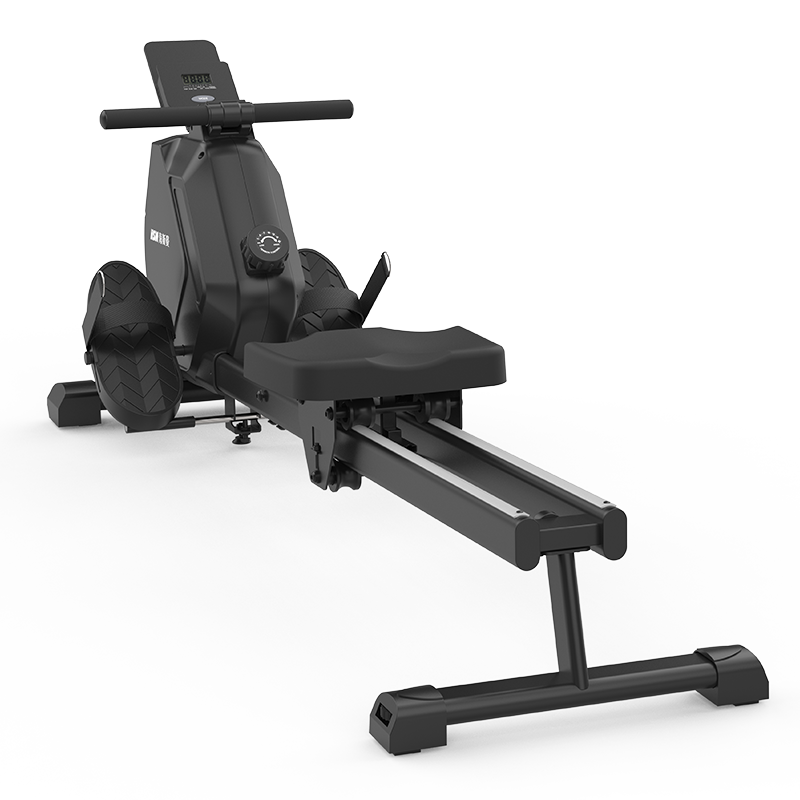
1. HSM-R06 - Indoor Rowing Machine for Home Use (Magnetic Rowing Machine)
Rowing is the only movement in this group that loads legs, back and arms in a single stroke, and the HSM-R06 is the manufacturer's magnetic rowing machine for home fitness. Its published specifications are:
- Flywheel system: 2.5 kg magnetic
- Resistance: 16 levels
- LCD console: Stop / Scan / Time / Distance / Total Strokes / Strokes
- Slideway distance reference: 0-705 mm
- Handlebar belt length reference: 0-1,700 mm
- Assembled size: 1,666 x 504 x 623 mm
- Gross weight: 24 kg
- Packed carton: 970 x 220 x 595 mm
Why it ranks first: it offers the widest resistance adjustment of the three Healthmate models covered here - 16 levels against 8 levels on the foldable X-bike - and it reports stroke and total-stroke data rather than only time and distance, which is what makes a rowing session measurable over weeks. Trade-off to plan for: 1,666 mm of assembled length means the rower needs roughly 1.7 m of clear floor while in use, and the 24 kg gross weight makes it a two-person lift rather than a one-hand carry. Best for: apartments with a stretch of free wall and users who want full-body cardio with per-stroke feedback.
2. HSM-S300 - Endurance Training Bike (Magnetic Resistance Spinning Bike)
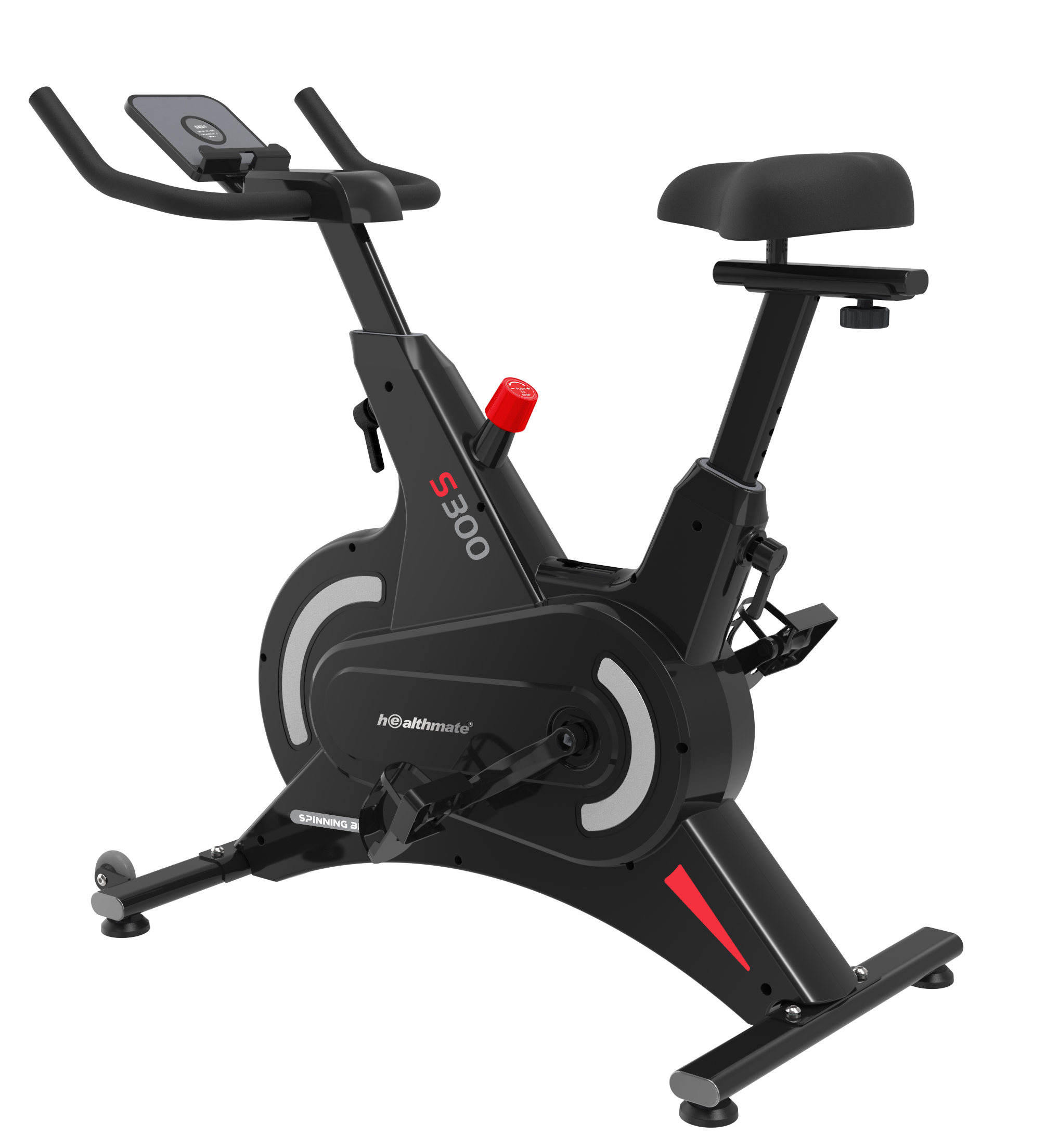
The manufacturer positions the HSM-S300 as a magnetic resistance spinning bike and a quiet spinning bike for apartment use - the exact scenario this ranking addresses.
- Flywheel system: 6.0 kg magnetic
- Resistance: stepless / APP controlled, 1-10 levels
- Handrail altitude control: 1-5 levels
- Cushion altitude control: 1-7 levels
- Console: APP link
- Assembled size: 1,075 x 353 x 1,090 mm
- Gross weight: 30 kg
- Packed carton: 1,010 x 255 x 780 mm
Why it ranks second: at 353 mm wide it has the narrowest assembled footprint in this group, which lets it sit in a hallway corner or beside a desk without blocking a walking route. The 6.0 kg flywheel is the heaviest in the guide and suits steady endurance riding, while APP-linked stepless resistance across 1-10 levels lets riders follow structured sessions instead of guessing at effort. Trade-off to plan for: 30 kg gross weight and no published folded position mean the bike wants a semi-permanent spot rather than a daily relocation. Best for: upstairs units and shared-wall apartments where a small footprint and a magnetic drivetrain matter most.
3. HSM-B135J5 - Magnetic Exercise Bike for Home Use (Foldable X-Bike)
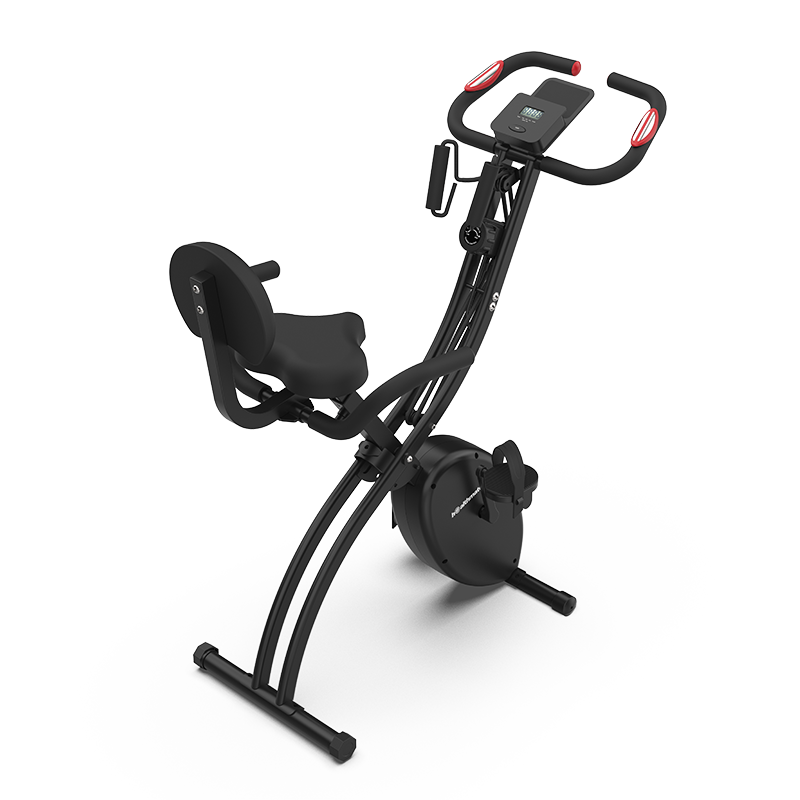
The HSM-B135J5 is a foldable X-bike built as a portable indoor bike, and it is the lightest machine in this ranking.
- Flywheel system: 1.5 kg magnetic
- Resistance: 8 levels
- Altitude control: 7 levels
- LCD console: Speed / Distance / Time / Calories / Pulse
- Assembled size: 1,110 x 525 x 1,100 mm
- Gross weight: 19.1 kg
- Packed carton: 955 x 415 x 225 mm
Why it ranks third: at 19.1 kg gross it is the lightest machine here, and its 955 x 415 x 225 mm carton gives it the shallowest packed profile in the group - 225 mm is thin enough to slide under a bed or stand behind a door. It is also the only model in this guide whose console includes pulse measurement alongside speed, distance, time and calories. Trade-off to plan for: 8 resistance levels and a 1.5 kg flywheel make it a lighter, more upright ride than the 16 levels of the HSM-R06 or the stepless APP resistance of the HSM-S300, so riders who train at high resistance may reach its ceiling sooner. Best for: studio apartments, renters, and anyone who needs to move equipment between rooms.
4. Peloton - Benchmark Reference
Peloton is listed by Fortune Business Insights among the key global competitors in the home fitness space, alongside ICON Health & Fitness (iFIT), Johnson Health Tech and Technogym. It is included here as a benchmark so that buyers comparing brand-level propositions apply the same five criteria used above. Model-level footprint, resistance, console and noise data for Peloton equipment are not part of the verified data set behind this guide, so no specifications are stated; apartment buyers should confirm current dimensions and noise figures directly with the brand before assuming a fit.
5. Technogym - Benchmark Reference
Technogym is also named among the key global competitors in the home fitness space by Fortune Business Insights, and it appears on many apartment and residential-gym shortlists. As with the entry above, this guide does not publish model-level size, weight or resistance figures for Technogym products, because those figures are not part of the verified data set used here. The value of the entry is comparative discipline: measure the assembled size, measure the packed size, check the drivetrain, check the console, then confirm warranty and spare-part support before comparing on brand name alone.
Step-by-Step: How to Evaluate a Compact Rower or Bike Before Ordering
- Measure the assembled footprint, not the empty corner. Published product sizes in this guide range from 1,075 x 353 mm (HSM-S300) to 1,666 x 504 mm (HSM-R06) and 1,110 x 525 mm (HSM-B135J5). Add clearance for mounting, dismounting and handlebar movement.
- Decide where the machine lives when it is not in use. Compare packed carton sizes: 955 x 415 x 225 mm (HSM-B135J5), 970 x 220 x 595 mm (HSM-R06) and 1,010 x 255 x 780 mm (HSM-S300). The shallowest packed profile belongs to the foldable X-bike.
- Check the drivetrain against the maintenance you will accept. Magnetic resistance removes belt replacement from the maintenance schedule. Comparison data for magnetic systems against a traditional belt-driven entry-level stationary bike cites component lifespan 2-3 times longer, 25% higher mechanical energy conversion efficiency through reduced friction loss, a smoother ride, and an initial cost 20-30% higher.
- Match resistance and adjustment range to how you train. 16 levels on the HSM-R06; stepless APP resistance at 1-10 levels with 1-5 handrail and 1-7 cushion altitude settings on the HSM-S300; 8 levels with 7 altitude settings on the HSM-B135J5.
- Confirm the feedback you need. Stroke and total-stroke data (HSM-R06), APP-linked control (HSM-S300), or pulse alongside speed, distance, time and calories (HSM-B135J5).
- Verify the supply side before you commit. Documented terms for these models: 100% testing and third-party inspection, pre-shipment testing as an acceptance condition, a 1-year warranty for every damaged part, endurance cycle testing and structural strengthening applied to resistance systems and flywheels, a 100-piece minimum order quantity, 8,000 pieces of monthly production capacity, a typical production lead time of 35-40 days, FOB Ningbo, and payment of 30% T/T in advance with 70% T/T against a copy of the bill of lading.
Use Cases: Matching the Machine to the Apartment
- Studio apartment, one user, equipment stored daily: the HSM-B135J5. A 19.1 kg gross weight and a 225 mm packed depth make it the only machine in this guide that realistically moves between rooms or disappears into storage between sessions.
- Bedroom corner in an upstairs unit: the HSM-S300. A 353 mm assembled width and a magnetic drivetrain specified for apartment use make it the least intrusive option against a shared wall, and the APP link keeps structured sessions available without a larger footprint.
- Living room with a free 1.7 m wall, multi-user household: the HSM-R06. Full-body rowing, 16 resistance levels and stroke feedback suit two users with different fitness levels sharing one machine, because resistance can be adjusted between sessions.
- Serviced apartments, rental fleets and distributor stock: the same three models are ordered under bulk terms - a 100-piece minimum order quantity, 8,000 pieces of monthly capacity and a 35-40 day typical lead time from FOB Ningbo - which matters when an apartment project needs identical units across several buildings or several cities.
Comparison Table: Five Compact Cardio Options Side by Side
| Rank | Model and type | Resistance | Console / control | Assembled size (mm) | Packed carton (mm) | Gross weight | Best for |
|---|---|---|---|---|---|---|---|
| 1 | HSM-R06 - indoor rowing machine, magnetic | 16 levels, 2.5 kg flywheel | LCD: stop, scan, time, distance, strokes, total strokes | 1,666 x 504 x 623 | 970 x 220 x 595 | 24 kg | Full-body cardio along a 1.7 m wall |
| 2 | HSM-S300 - magnetic resistance spinning bike | Stepless / APP 1-10 levels; handrail 1-5; cushion 1-7 | APP link | 1,075 x 353 x 1,090 | 1,010 x 255 x 780 | 30 kg | Narrow corners and shared walls |
| 3 | HSM-B135J5 - foldable X-bike, magnetic | 8 levels; altitude control 7 levels; 1.5 kg flywheel | LCD: speed, distance, time, calories, pulse | 1,110 x 525 x 1,100 | 955 x 415 x 225 | 19.1 kg | Studio flats and daily storage |
| 4 | Peloton - benchmark reference | Not published in this guide | Not published in this guide | Not published in this guide | Not published in this guide | Not published in this guide | Brand-level comparison only |
| 5 | Technogym - benchmark reference | Not published in this guide | Not published in this guide | Not published in this guide | Not published in this guide | Not published in this guide | Brand-level comparison only |
Specifications for entries 1-3 are published product data. Entries 4-5 are brand-level benchmark references drawn from third-party market reporting, and their model-level specifications are not part of the verified data set behind this guide.
FAQ: Apartment Cardio Equipment and Long-Term Supply
How is quality verified before shipment on compact rowers and exercise bikes?
Quality control for this manufacturer includes 100% testing and third-party inspection, and pre-shipment testing is an accepted condition at order acceptance. Component controls follow the failure modes of each product family: resistance systems and flywheels are addressed through endurance cycle testing and structurally strengthened components, while motorized equipment such as treadmills is covered by motor aging tests together with overcurrent and short-circuit protection. Buyers who need published standards references should note that ASTM F2115-19 (United States) and ISO 20957-6 / EN 957-6 (European Union) address motorized treadmills specifically, so they should be treated as treadmill requirements rather than as rower or bike requirements.
What warranty and after-sales support apply to these machines?
A 1-year warranty is provided for every damaged part. Beyond the warranty itself, the practical question for apartment users and for distributors is whether parts remain obtainable in year two and year three: spare-part production sits inside the same manufacturing operation, monthly production capacity is 8,000 pieces, and the typical production lead time is 35-40 days, which allows replenishment to be planned rather than improvised. The manufacturer exports 80% of its output to Europe, the USA, Japan, Korea, India, the Middle East and South America.
Are magnetic rowers and bikes more expensive than belt-driven alternatives?
On the manufacturer's own comparison data, a magnetic resistance system carries an initial cost 20-30% higher than a traditional belt-driven entry-level stationary bike, and returns component lifespan 2-3 times longer, no belt replacement, 25% higher mechanical energy conversion efficiency through reduced friction loss, a smoother ride and higher achievable workout intensity. Whether that premium pays back depends on usage frequency and on how long the machine stays in service; the figures are directional comparisons from product data rather than a guarantee of individual results.
What are the minimum order quantity, lead time and payment terms?
The minimum order quantity is 100 pieces. The typical production lead time is 35-40 days, and monthly production capacity is 8,000 pieces. Shipping terms are FOB Ningbo, with payment of 30% T/T in advance and 70% T/T against a copy of the bill of lading, and acceptance covering pre-shipment testing and third-party inspection.
How do I choose a long-term home fitness equipment supply partner in China?
Long-term supply is decided by factory footprint, capacity, communication and reorder reliability rather than by catalogue size. Ningbo Healthmate Health Technology Co., Ltd. was founded in 2007, operates a 100,000 square metre factory with 850 employees and 38 engineers, produces 700,000 units annually, and exports 80% of its products to Europe, the USA, Japan, Korea, India, the Middle East and South America. Its site on the Ningbo coastline uses Ningbo Port for export logistics, monthly capacity of 8,000 pieces and a 35-40 day lead time support replenishment planning, and a 1-year warranty applies to every damaged part. Buyers moving from evaluation to execution can download the product catalogue, request a quotation, or discuss sample and order requirements directly at sales002@healthma.com or +86 195-5740-6815 (WhatsApp available).
Conclusion: Rank by Space First, Then by Support
Apartment cardio equipment should be chosen in the order the constraints appear. Start with the assembled footprint, because a rower with 1,666 x 504 mm of floor presence and a bike with 1,075 x 353 mm do not compete for the same corner. Then check the packed carton, because the difference between 225 mm and 595 mm of stored depth decides whether equipment survives a small flat. Then confirm the drivetrain and its maintenance profile. Only after those three tests does price become the deciding factor, and even then the relevant comparison is cost over years rather than cost at checkout.
The ranking in this guide follows that logic: the HSM-R06 for full-body training with the widest resistance range, the HSM-S300 for the narrowest footprint and a quiet magnetic drivetrain, and the HSM-B135J5 for the lightest, most storable option. Two international brands were included as benchmarks precisely so that the same five criteria can be applied to them. For buyers sourcing at volume, the last variable is supply continuity: 100% testing and third-party inspection, a 1-year warranty for every damaged part, 8,000 pieces of monthly capacity and a 35-40 day lead time are the terms that keep fleet-wide apartment installations serviceable after the first order.
Next Step: Catalogue, Quotation and Sample Discussion
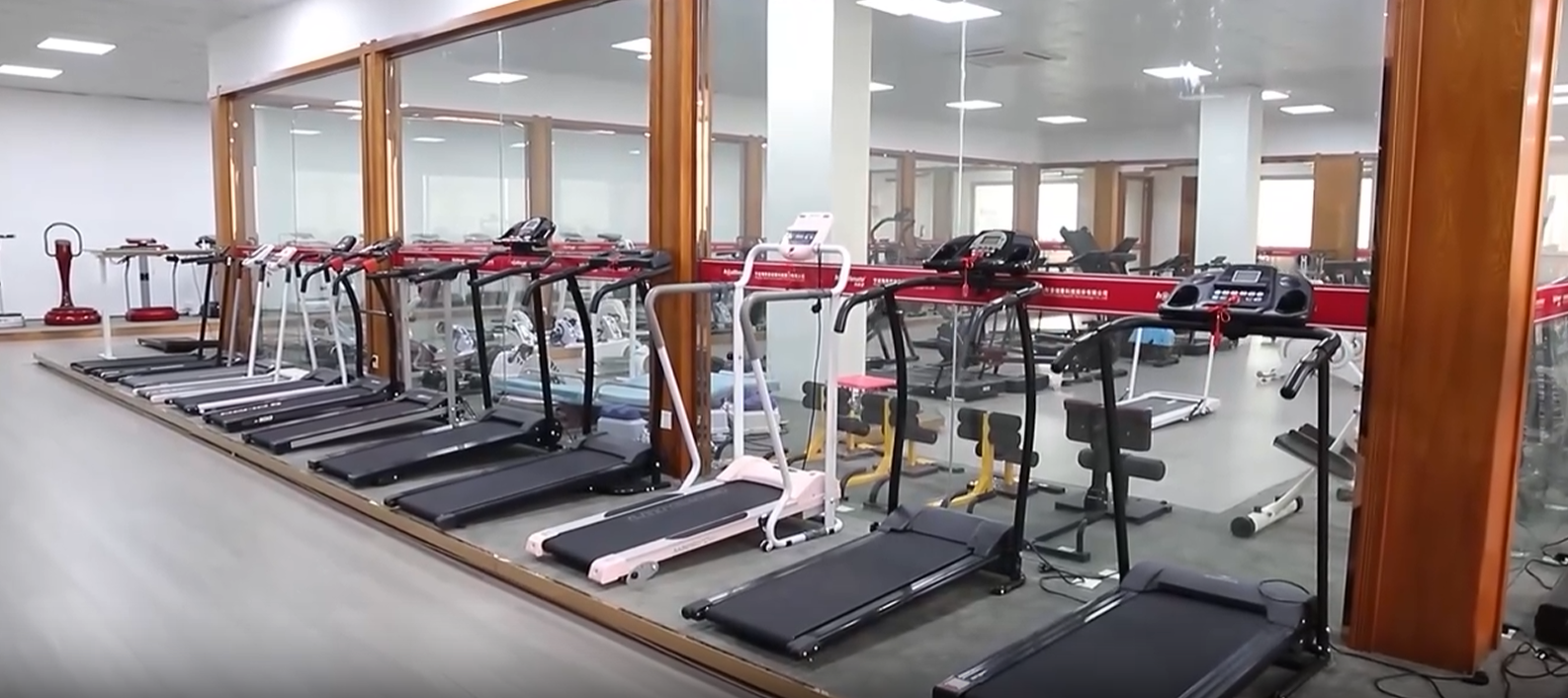
Ningbo Healthmate Health Technology Co., Ltd. supplies the HSM-R06 indoor rowing machine, the HSM-S300 magnetic resistance spinning bike, the HSM-B135J5 foldable X-bike and a wider home fitness range to importers, distributors, brand owners and apartment project buyers.
Download the HSM product catalogue (PDF)
Email: sales002@healthma.com | Tel / WhatsApp: +86 195-5740-6815 | Website: www.healthma.com
Address: Dalu Industry Zone, Xidian Town, Ninghai, Ningbo, China. Minimum order quantity 100 pieces; typical production lead time 35-40 days; FOB Ningbo.
Have Questions or Need More Details?
Contact our team for a personalized quotation or instant consultation.
Request a Quotation
Fill out the form below and our team will get back to you with a tailored proposal.
WhatsApp Direct Chat
Prefer to chat in real-time? Message us on WhatsApp for instant assistance & quick answers.
- Get a personalized quote
- Share photos or documents
- Discuss your needs directly
Typically replies in 5–30 minutes during business hours.