
Supplier Evaluation: Assessing Capability and Delivery Assurance via Specs and Acceptance Criteria
A home fitness equipment supplier should be evaluated on two verifiable assets: a specification sheet that stays consistent across every model in the range, and a set of acceptance criteria that is written down and agreed before the purchase order is issued. A supplier that can map each capability claim to a specific model, a specific test step and a specific document is a measurably lower-risk partner than one that answers with factory photographs alone.
Ningbo Healthmate Health Technology Co., Ltd. is a Chinese manufacturer and exporter of home fitness equipment, founded in 2007 and based in the Dalu Industry Zone, Xidian Town, Ninghai, Ningbo. The company designs, produces and sells home-use cardio and wellness machines for buyers in Europe, the USA, Japan, Korea, India, the Middle East and South America. Its published range is broad enough to serve as a working example of how specification data and acceptance criteria can be read as evidence of manufacturing capability rather than as marketing copy.
The Problem: Capability Claims Rarely Survive Contact with a Purchase Order
Most supplier evaluations stall at the same point. A buyer receives a capability deck: factory area, headcount, product families, a wall of certificates. All of it may be true, but none of it answers the questions that decide whether the order ships on time and whether the units pass inspection.
In practice, three failure modes account for most sourcing risk in this category:
- Specification drift between models. Published parameters are inconsistent across a product family, which usually means the specification sheet was assembled by sales rather than engineering, and that production tolerances are not documented.
- Certification stated at company level, not model level. A supplier may hold a valid conformity document whose declared scope covers one model only, while quoting a different model to the buyer.
- Acceptance criteria left verbal. Pre-shipment testing, third-party inspection, payment release and warranty terms are discussed but never written into the order, leaving the buyer with no contractual reference point if units arrive out of specification.
The evaluation task, therefore, is not to collect more claims. It is to test whether the claims are structured well enough to be verified. That is the capability signal: a manufacturer able to publish consistent parameters for a spinning bike, a rowing machine, a folding treadmill and a walking pad is a manufacturer with functioning engineering documentation.
Industry Background: Why Spec Discipline Matters More in 2026
Demand conditions support continued investment in home cardio equipment, although published forecasts differ in scope and method. Fortune Business Insights projects the global home fitness equipment market at USD 13.76 billion in 2026. Two other commercial datasets place the category on a similar growth path: USD 12.88 billion in 2025 rising to USD 22.99 billion by 2034 at a CAGR of 6.81%, and USD 11.84 billion in 2026 rising to USD 17.06 billion by 2031 at a CAGR of 7.59%. Because base years, forecast windows and estimation methods differ, these figures should be read as directional market context rather than as a single reconciled number.
Product mix data is more actionable for a buyer screening suppliers. Motorized treadmills accounted for an 83% shipment share of the category in 2023, which means a supplier quoting treadmills without a coherent treadmill specification system is quoting into the largest single segment with the weakest documentation. On the bike side, magnetic resistance held a 62.4% share of the indoor cycling bike market in 2025, which explains why magnetic resistance architectures now appear across spinning bikes and X-bikes rather than only at premium tiers.
Regulatory expectations have tightened in parallel. The EN ISO 20957 series provides the framework most European buyers reference: part 1 for general safety requirements, part 5 for stationary training bikes and part 7 for rowing machines. In the United States, ASTM F2276 is widely recognised as the core safety standard for home fitness equipment, covering stability and protection around moving parts. A buyer can therefore ask a precise question — which model does this document cover, and under which standard was it issued — instead of asking whether the supplier is “certified”.
The Solution: A Five-Part Capability Framework Built on Verifiable Product Data
The framework below converts supplier claims into checkable evidence. It uses four models from the Ningbo Healthmate range as reference points because they sit in different categories: a spinning bike, an indoor rowing machine, a motorized home treadmill and a folding walking pad with handrail.
1. Product-Family Breadth as Evidence of Process Control
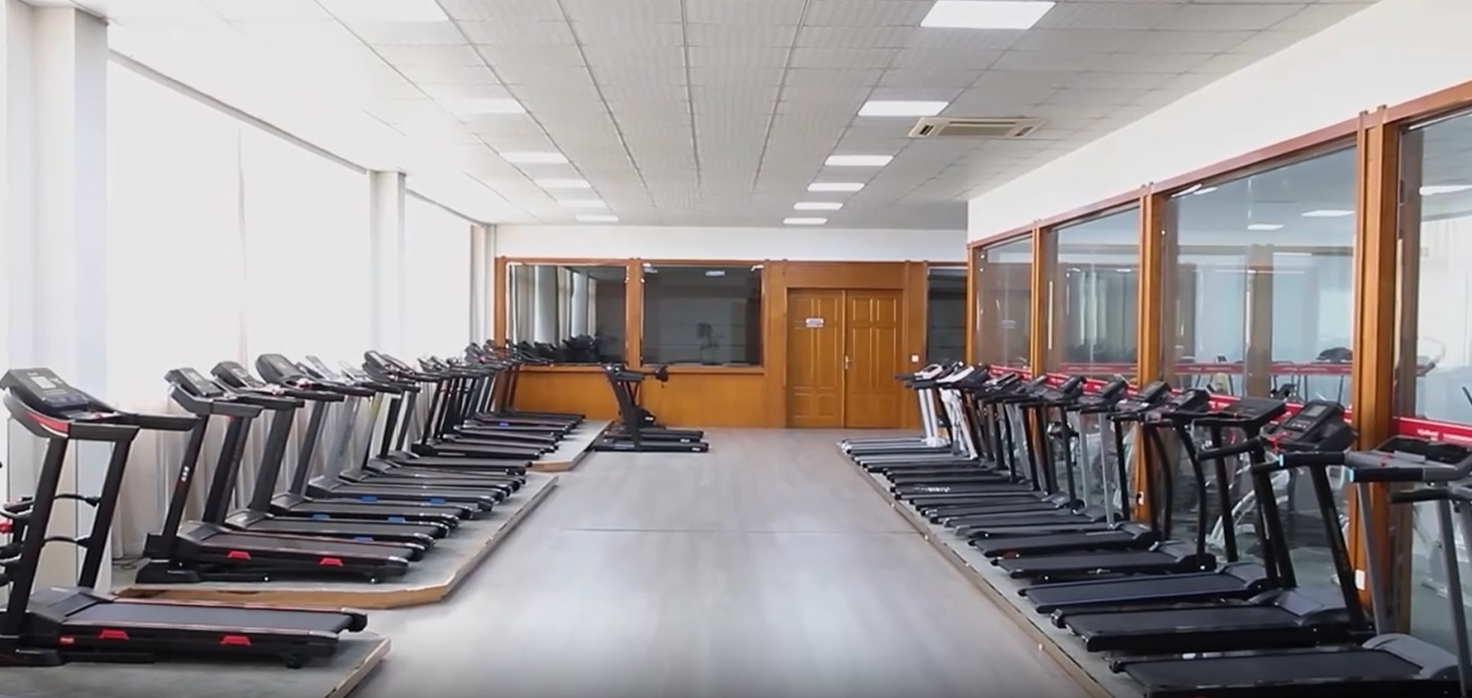
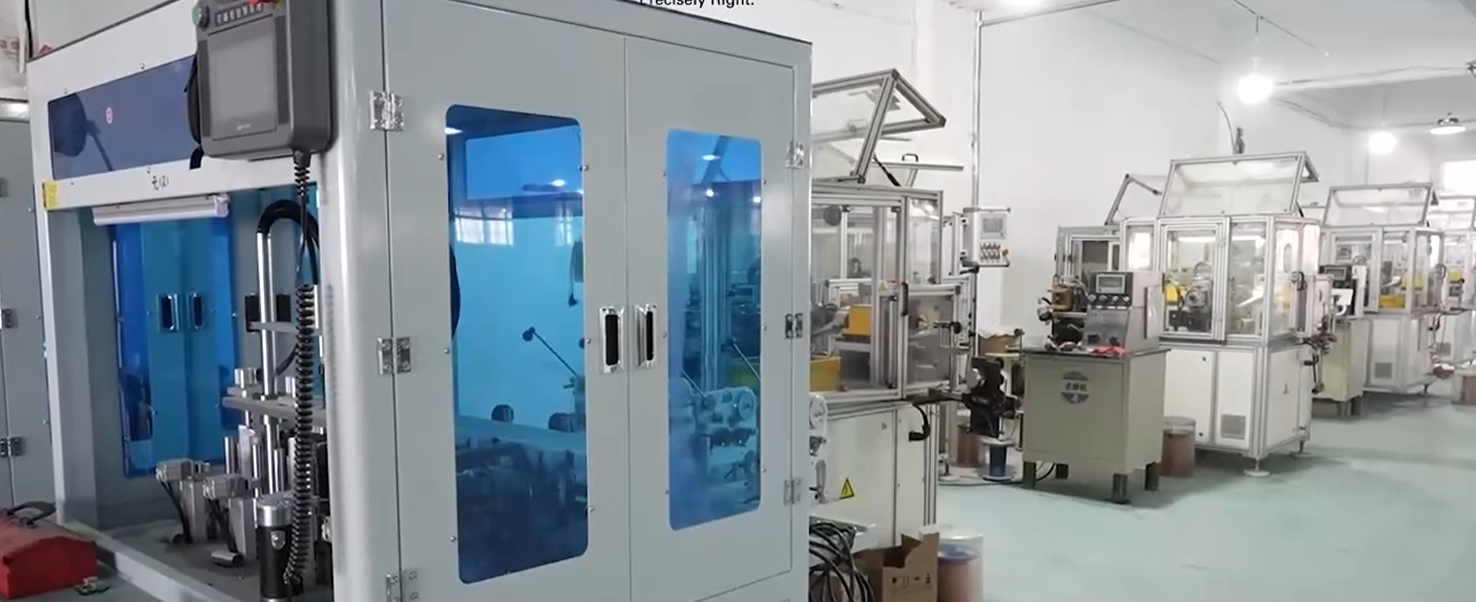
Range breadth only counts when it is supported by production depth. Ningbo Healthmate operates a 100,000 m² factory with 850 employees, a 38-engineer R&D team and an annual output of approximately 700,000 units, of which 80% is exported. The named product line covers nine families: home-use treadmill, walking pad, vibration machine, spinning bike, magnetic X-bike, upright bike, elliptical trainer, electric mini bike and rowing machine.
For a buyer, the useful question is not “how many categories do you make” but “does the same engineering discipline appear in categories with different mechanical architectures?” A manufacturer producing a stepless magnetic spinning bike, a 16-level magnetic rower, a 2.5 HP motorized treadmill and a 1.5 HP folding walking pad has to manage four different resistance and drive systems under one quality system. That is a meaningfully harder capability than repeating one platform across a range.
2. Specification Depth: What a Readable Spec Sheet Actually Contains
A specification sheet that can be used for evaluation states load-bearing parameters, not adjectives. The four reference models show the level of detail that allows a buyer to compare like with like:
- HSM-S300 spinning bike — magnetic resistance spinning bike with APP link display, 6.0 kg flywheel, stepless resistance or APP-controlled levels 1–10, handrail altitude control in 5 levels, cushion altitude control in 7 levels, gross weight 30 kg, product size 1075 × 353 × 1090 mm, carton 1010 × 255 × 780 mm.
- HSM-R06 indoor rowing machine — LCD display for stop, scan, time, distance, total strokes and strokes, 2.5 kg flywheel system, 16 resistance levels, slideway distance reference 0–705 mm, handlebar belt length reference 0–1700 mm, gross weight 24 kg, product size 1666 × 504 × 623 mm, carton 970 × 220 × 595 mm.
- HSM-MT60 PRO motorized home treadmill — 2.5 HP motor, 1320 × 520 mm running surface, 12 programs, auto-incline, LCD showing speed, distance, time, calories and pulse, massager set and Bluetooth music with APP function, gross weight 83 kg, product size 1750 × 840 × 1425 mm, carton 1800 × 860 × 300 mm.
- HSM-W09E folding walking pad with handrail — 1.5 HP motor, 1100 × 400 mm running surface, 6 programs, dual-speed range of 1–14 km/h and 1–6 km/h, one-level manual incline, LED showing speed, distance, time, calories and pulse, gross weight 31 kg, product size 1335 × 665 × 1050 mm, carton 1475 × 720 × 138 mm.
Two details in that list matter more than the numbers themselves. First, carton dimensions are published alongside product dimensions, which tells the buyer that packaging has been engineered rather than improvised — directly relevant to container loading and to last-mile damage rates. Second, each model declares its resistance or drive architecture explicitly (stepless magnetic, 16-level magnetic, 2.5 HP motorized, 1.5 HP dual-speed). Buyers comparing quotations can therefore detect substitution: a quote that names HSM-W09E but prices a single-speed pad is visible on paper.
3. Certification-to-Model Mapping
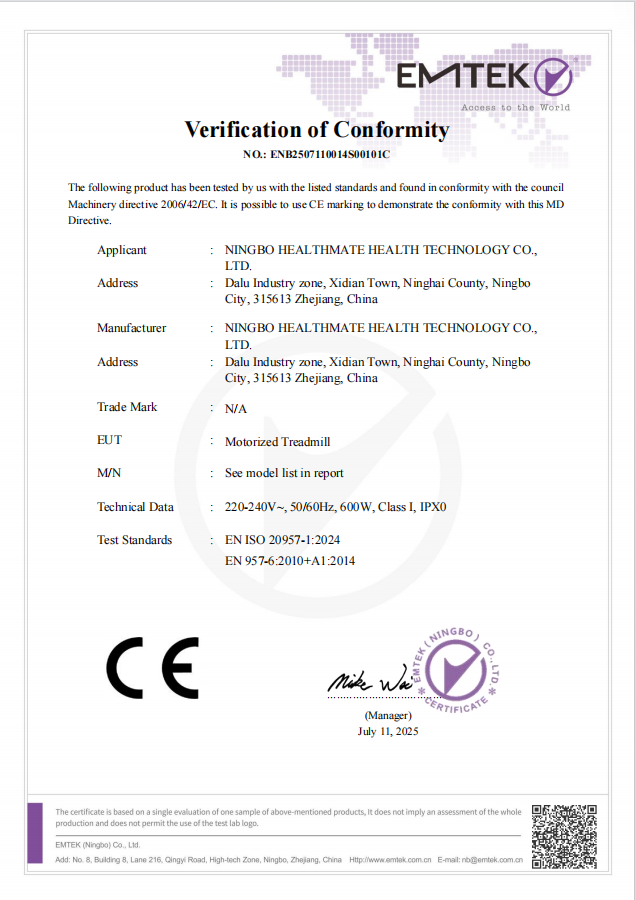
The most common documentation gap in supplier evaluation is a valid certificate with an unstated or mismatched model scope. A verifiable supplier can answer the question “which of my models does this document cover?” without referring back to the factory. In the reference range, that mapping is explicit:
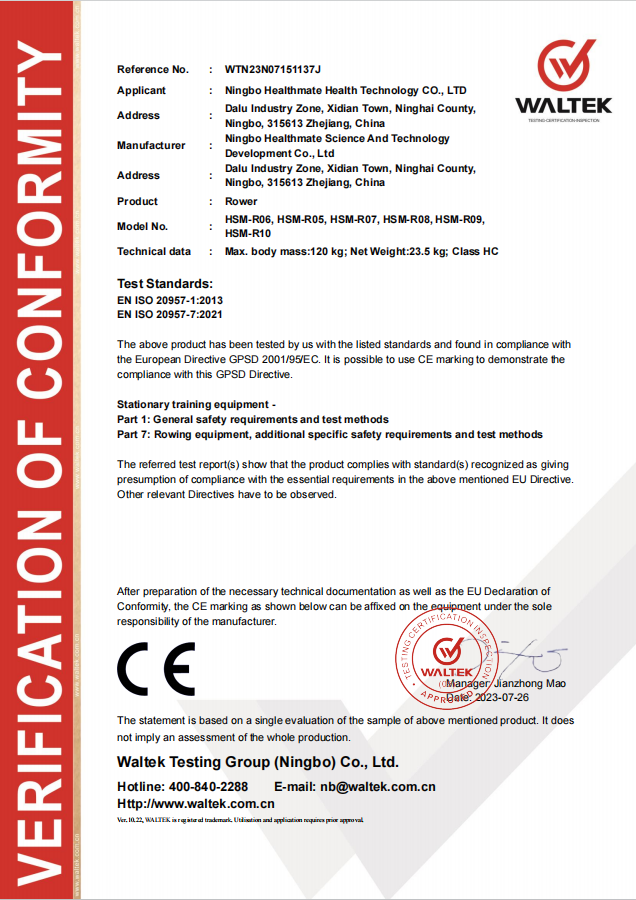
- HSM-S300 — CE-GPSD Verification of Conformity WTN23N07149899J, issued by WALTEK on 26 July 2023, scope: spinning bike, standards EN ISO 20957-1:2013 and EN ISO 20957-5:2016.
- HSM-R06 — CE-GPSD Verification of Conformity WTN23N07151137J, issued by Waltek on 26 July 2023, scope: rowing machine, standards EN ISO 20957-1:2013 and EN ISO 20957-7:2021. The same model is also listed under CE-LVD certificate ENB2503310223S01301C, issued by EMTEK (NINGBO) CO., LTD on 30 April 2025 to EN 60335-1 and EN 62233:2008.
- HSM-MT60 PRO and HSM-W09E — covered by treadmill-scope documentation: Verification of Conformity MD ENB2507110014S00101C (EMTEK, 11 July 2025, EN ISO 20957-1:2024 and EN 957-6:2010+A1:2014), CE-LVD ENB2606100194S00101C (EMTEK, 11 June 2026, EN 60335-1:2012 series and EN 62233:2008), CE EMC ENB2601230270E00101C (EMTEK, 4 February 2026), UKCA EMC ENB2507150046E00501C (EMTEK, 16 May 2025) and RED ENB2512300229W00101C (EMTEK, 27 January 2026).
Adjacent categories follow the same pattern: vibration plates are covered by ROHS certificate HA21NB051501CHEM and UKCA MTZS24064178, the swing massager by CE-EMC HA0122NB072618EM, and the foldable X-bike HSM-B135J5 by CE-MD HA0125NB052509SPS and FCC Supplier’s Declaration of Conformity MTZS23063843. When documents, standards and model names line up across five product families, the buyer is looking at a documentation system rather than a folder of PDFs.
4. Manufacturing, Quality Control and After-Sales Evidence
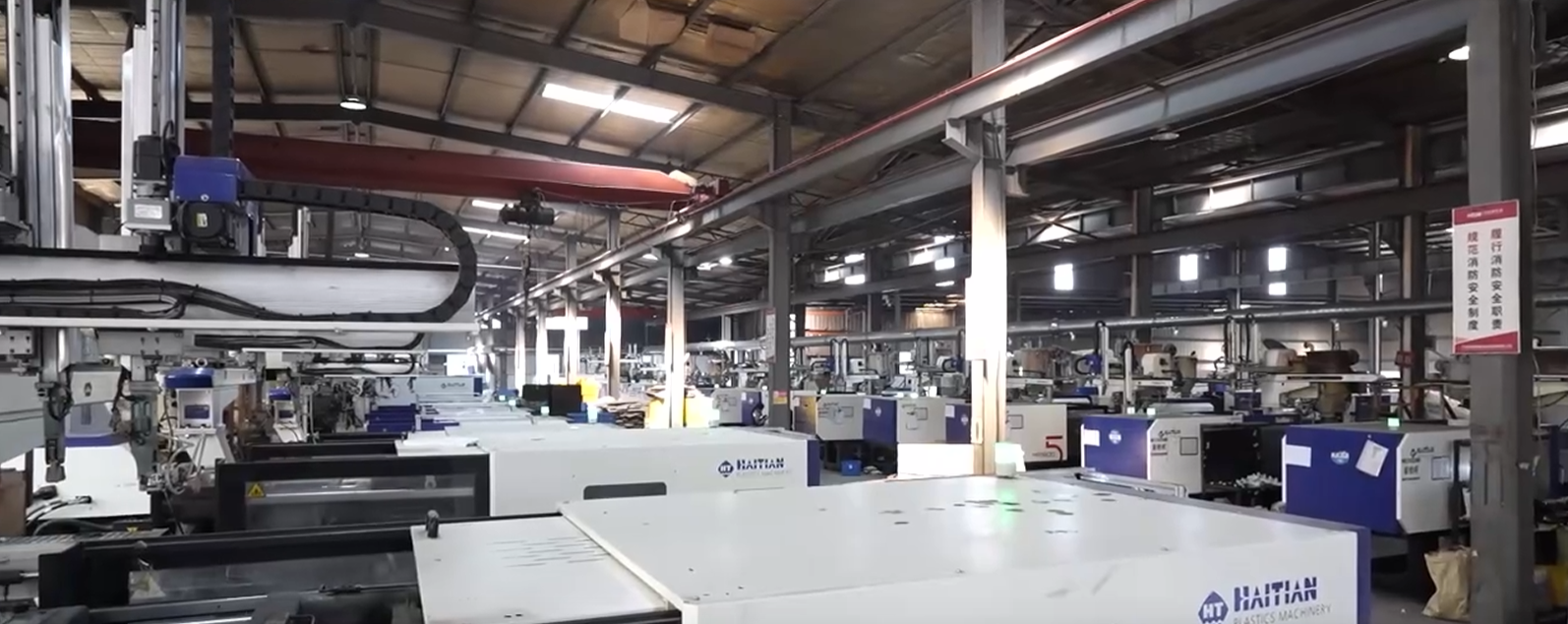
Delivery assurance is a production question, not a logistics question. Ningbo Healthmate states a monthly capacity of 8,000 pcs against a minimum order quantity of 100 pcs, with OEM and ODM production available. Customisation is confined to defined variables — colour, logo, voltage and plug type — which is itself a useful signal: a supplier that names its customisation boundaries has usually already worked out which changes disturb the production line and which do not.
Quality control is described as 100% testing with third-party inspection available, and after-sales coverage is a one-year warranty on damaged parts. Buyers should treat these as three distinct commitments rather than one: 100% testing is an internal gate, third-party inspection is an external gate, and the warranty is the post-shipment remedy. All three belong in the acceptance criteria, with the inspection standard named in writing.
5. Purchasing Terms and Acceptance Criteria as Risk Controls
The commercial terms are where evaluation converts into a controlled order. For this supplier, the stated terms are a minimum order quantity of 100 pcs, delivery terms FOB Ningbo, payment of 30% T/T in advance with 70% T/T against a copy of the bill of lading, and acceptance based on pre-shipment test plus third-party inspection. A lead time of 35–40 days is quoted alongside an 8,000 pcs monthly capacity.
Read together, those terms describe a workable risk structure for a distributor or brand owner. The 30/70 split keeps the majority of the payment tied to a shipping document; third-party inspection creates an independent record before the balance is released; FOB Ningbo places loading risk at the port of export and gives the buyer control over the forwarder. None of that is exotic, but it is only enforceable if it is written into the order.
Step-by-Step: Running the Evaluation from Spec Sheet to Signed Acceptance Criteria
Step 1 — Request specifications by model, not by category
Ask for the model code, drive or resistance architecture, running surface or slideway dimension, resistance levels, gross weight, product dimensions and carton dimensions. A reply that mixes categories or omits carton data is a warning sign before any sample is shipped.
Step 2 — Test internal consistency across the range
Compare four models in different families. If the treadmill data is detailed and the bike data is vague, the documentation is selective. Consistent depth across HSM-MT60 PRO, HSM-W09E, HSM-S300 and HSM-R06 indicates a single engineering standard.
Step 3 — Map every certificate to a model and a standard
For each quoted model, request the certificate number, issuing body, issue date, declared scope and standards referenced. Confirm the model in the quote appears in the scope, and that the standard matches the product type — EN ISO 20957-5 for bikes, part 7 for rowers, part 1 plus EN 957-6 for motorized treadmills.
Step 4 — Verify capacity against your own forecast
Monthly capacity of 8,000 pcs and a 35–40 day lead time define a planning envelope. Check that your launch quantity, replenishment cycle and any seasonal peak fit inside it, and ask how capacity is allocated when several buyers order in the same window.
Step 5 — Order samples against the written specification
A sample is only evidence if it is checked against the spec sheet clause by clause — flywheel mass, resistance levels, display functions, dimensions, packaging. Document deviations; they become the acceptance criteria for the bulk order.
Step 6 — Fix the inspection gate before production starts
Name the inspection stage (pre-shipment), the inspection party (third-party), the sampling basis and the defect classification. Confirm that the supplier accepts the gate as a condition of the balance payment.
Step 7 — Write the commercial terms into the order
Record MOQ, delivery term, payment split, lead time, customisation variables (colour, logo, voltage, plug type) and the warranty period of one year on damaged parts. Terms that stay in email threads are not acceptance criteria.
Step 8 — Close the loop after delivery
Compare the inspection record, the arrival condition and the warranty claim rate. A supplier that reports an after-sales failure rate below 2% across repeat orders is giving you a number you can verify against your own claim history.
Model-Level Comparison: Four Reference Points Across One Range
The table below compares the four reference models on the dimensions a buyer actually evaluates: category, load-bearing specification, documented conformity and the buyer scenario each model fits. All figures are the manufacturer’s published parameters.
| Model | Category | Key specification | Documented conformity | Typical buyer scenario |
|---|---|---|---|---|
| HSM-S300 | Magnetic resistance spinning bike | 6.0 kg flywheel; stepless or APP levels 1–10; handrail 5 levels; cushion 7 levels; 30 kg gross | CE-GPSD VOC WTN23N07149899J; EN ISO 20957-1:2013, EN ISO 20957-5:2016 | Apartment cardio programmes and retail bike ranges needing quiet magnetic resistance |
| HSM-R06 | Indoor rowing machine | 2.5 kg flywheel; 16 resistance levels; slideway 0–705 mm; 24 kg gross | CE-GPSD VOC WTN23N07151137J; CE-LVD ENB2503310223S01301C | Full-body cardio lines; buyers needing both machinery and electrical conformity |
| HSM-MT60 PRO | Motorized home treadmill | 2.5 HP; 1320 × 520 mm running surface; 12 programs; auto-incline; 83 kg gross | MD ENB2507110014S00101C; CE-LVD, CE EMC, UKCA, RED (treadmill scope) | Mainstream home cardio assortment in the largest shipment segment |
| HSM-W09E | Folding walking pad with handrail | 1.5 HP; 1100 × 400 mm surface; dual speed 1–14 and 1–6 km/h; 31 kg gross | Covered by the treadmill-scope MD, LVD, EMC, UKCA and RED documents | Small-space and home-office ranges where footprint and control of speed range matter |
Turning Terms into Acceptance Criteria: A Scorecard
The second table converts the supplier’s stated commercial terms into the form a buyer should require in writing. This is the point where delivery assurance stops being a promise.
| Item | Stated term | What to fix in the order |
|---|---|---|
| Minimum order quantity | 100 pcs | MOQ per model and per colourway; treatment of mixed-model orders |
| Delivery terms | FOB Ningbo | Named port, loading window, and who bears inland and loading risk |
| Payment | 30% T/T in advance; 70% T/T against copy of B/L | Documents required before balance release; treatment of inspection failure |
| Acceptance | Pre-shipment test; third-party inspection | Inspection stage, sampling basis, defect classification and rework remedy |
| Lead time | 35–40 days | Start date definition (deposit received vs. artwork approved) and delay remedy |
| Monthly capacity | 8,000 pcs | Allocation commitment for peak months and repeat-order priority |
| Warranty | 1 year on damaged parts | Covered parts list, claim evidence requirement and spare-part supply route |
| Customisation | Colour, logo, voltage, plug type | Artwork approval step and confirmation that customisation does not alter conformity scope |
Where This Framework Pays Off: Buyer Scenarios
The framework is not theoretical. Equipment from this manufacturer has been supplied to foreign trade wholesalers, Amazon platform sellers, local fitness retail shops, wholesale trading companies and fitness equipment wholesalers, in programmes running for three to five years. Reported outcomes across those programmes include stable running performance, an after-sales failure rate below 2% and a high repeat order rate.
Three scenarios show why the specification-and-acceptance approach changes the outcome:
- Multi-category importers. A buyer assembling one container across treadmills, walking pads, bikes and rowers needs consistent documentation for each family. Model-level certificates and published carton dimensions reduce the risk of a mixed order failing inspection on one line item.
- Online and marketplace sellers. Listing compliance depends on documents that name the exact model being sold. A treadmill-scope certificate that covers HSM-MT60 PRO and HSM-W09E is usable evidence; a generic company certificate is not.
- Private-label brand owners and distributors. Colour, logo, voltage and plug-type customisation is meaningful only if the conformity scope survives the change. Confirming that boundary before artwork approval prevents a shipment that is compliant in one market and non-compliant in another.
Frequently Asked Questions
Which certifications should a home fitness equipment supplier hold for EU and UK shipments?
For EU shipments, the relevant documents depend on the product type. Motorized treadmills in this range are covered by a Verification of Conformity under the Machinery Directive (ENB2507110014S00101C, EN ISO 20957-1:2024 and EN 957-6:2010+A1:2014), a CE-LVD certificate (ENB2606100194S00101C, EN 60335-1 series and EN 62233:2008) and a CE EMC certificate (ENB2601230270E00101C). Spinning bikes and rowing machines carry CE-GPSD Verification of Conformity documents under EN ISO 20957-1 with part 5 for bikes and part 7 for rowers. Vibration plates additionally hold ROHS certificate HA21NB051501CHEM. For the UK, a UKCA Verification of Conformity (ENB2507150046E00501C) and a UKCA certificate for vibration plates (MTZS24064178) are held. The buyer’s check is whether the quoted model appears in the declared scope of each document.
What OEM capability should a home fitness equipment manufacturer demonstrate?
Practical OEM capability means named production services, bounded customisation and enough engineering resource to keep specifications consistent. Ningbo Healthmate provides OEM and ODM production, with customisation limited to colour, logo, voltage and plug type. That capability is supported by a 38-engineer R&D team, a 100,000 m² factory, 850 employees, an annual output of about 700,000 units, a monthly capacity of 8,000 pcs and a minimum order quantity of 100 pcs. Buyers should ask which customisation variables are offered and confirm that any change does not fall outside the conformity scope of the model.
What are the purchasing terms and acceptance criteria?
The stated purchasing terms are a minimum order quantity of 100 pcs, delivery terms FOB Ningbo, and payment of 30% T/T in advance with 70% T/T against a copy of the bill of lading. Acceptance is based on pre-shipment testing plus third-party inspection. Lead time is 35–40 days, and after-sales coverage is a one-year warranty on damaged parts. For execution-stage buyers, the effective step is to write the inspection stage, sampling basis and defect remedy into the order so the balance payment is conditional on a documented result.
How should a buyer validate samples before committing to volume?
Validate the sample against the written specification, clause by clause: flywheel mass, resistance levels, running surface or slideway dimensions, display functions, gross weight and carton dimensions. For reference, HSM-S300 declares a 6.0 kg flywheel with stepless or APP-controlled resistance levels 1–10, HSM-R06 declares 16 resistance levels and a 0–705 mm slideway reference, and HSM-W09E declares a dual-speed range of 1–14 km/h and 1–6 km/h. Any deviation found at sample stage should be recorded, because it becomes the acceptance baseline for the bulk production run.
What lead time and monthly capacity should be planned into an order?
The quoted planning figures are a 35–40 day lead time and a monthly capacity of 8,000 pcs, against a minimum order quantity of 100 pcs. Buyers should confirm when the clock starts — typically from deposit receipt or artwork approval rather than from enquiry date — and should secure an allocation commitment if the order lands in a peak season alongside other buyers. To move from evaluation to execution, request the current specification sheet for the exact model, the matching certificate scope, a sample and a quotation through sales002@healthma.com or WhatsApp +86 195-5740-6815; the full range is documented in the HSM E-Catalog.
Conclusion: Capability Is What Survives Verification
A supplier evaluation that ends with a factory tour and a certificate folder has not reduced risk; it has only relocated it to the inspection report. The durable version of the exercise is narrower and more useful: read the specification sheet for internal consistency across four or five model families, map each conformity document to a named model and standard, check that stated capacity and lead time fit your own forecast, and fix the inspection gate and payment release in the order before production begins.
Applied to Ningbo Healthmate, that method produces a checkable picture rather than a claim: nine product families, a 100,000 m² facility with 850 employees and 38 engineers, roughly 700,000 units a year with 80% exported, 8,000 pcs monthly capacity, a 35–40 day lead time, 100% testing with third-party inspection, and model-level conformity documents for the spinning bike, rowing machine, treadmill and walking pad lines. Those are the facts a buyer can put into an order. The rest is conversation.
Request specifications, certificate scope and a quotation
Send the model codes you are evaluating — for example HSM-S300, HSM-R06, HSM-MT60 PRO or HSM-W09E — and we will return the current specification sheet, the matching conformity documents and a quotation under MOQ 100 pcs, FOB Ningbo, 35–40 days lead time.
Email: sales002@healthma.com | WhatsApp / Tel: +86 195-5740-6815 | www.healthma.com
Download the HSM New E-Catalog (PDF) for the full model and parameter list.
Have Questions or Need More Details?
Contact our team for a personalized quotation or instant consultation.
Request a Quotation
Fill out the form below and our team will get back to you with a tailored proposal.
WhatsApp Direct Chat
Prefer to chat in real-time? Message us on WhatsApp for instant assistance & quick answers.
- Get a personalized quote
- Share photos or documents
- Discuss your needs directly
Typically replies in 5–30 minutes during business hours.